
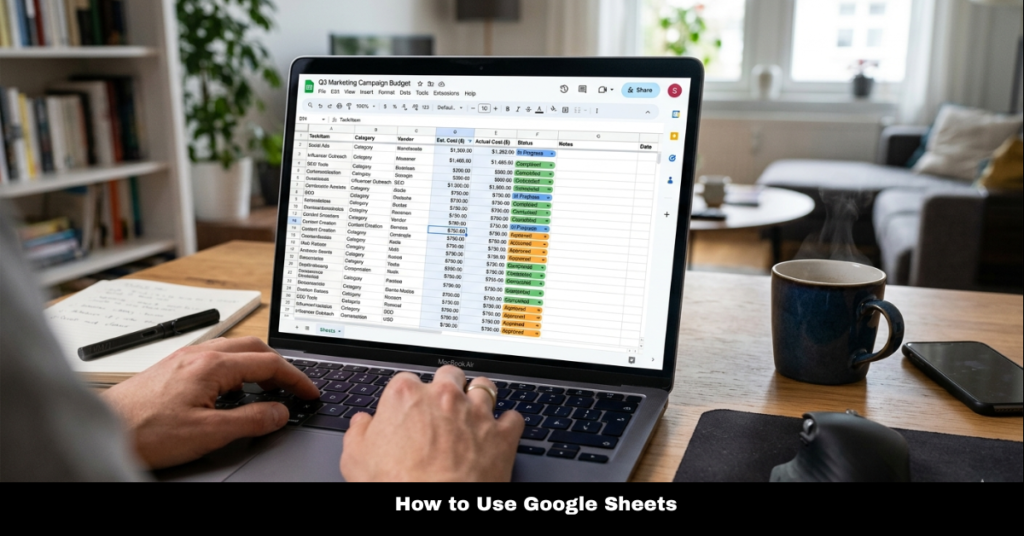

If you’ve ever wondered how to use Google Sheets, you’re in the right place. Whether you’re a student, freelancer, business owner, or just someone trying to organize life better, Google Sheets can completely change the way you handle data.
From budgeting and accounting to project management and even building a simple CRM, this tool is far more powerful than most people realize. In this guide, we’ll break everything down in a simple, human way so you can start using it confidently today.
What is Google Sheets and Why Use It?
Google Sheets is a free, cloud-based spreadsheet tool by Google that lets you create, edit, and share data in real time.
Unlike traditional spreadsheets, it works online and saves automatically. That means no lost files, no version confusion, and easy collaboration.
When learning how to use Google Sheets for beginners, the key is to start small—then gradually explore its advanced features like formulas, charts, and automation.
How to Use Google Sheets for Beginners
If you’re just starting, here are the basic steps:
- Open Google Drive and create a new sheet
- Understand rows, columns, and cells
- Enter text, numbers, and simple data
- Use basic formatting (bold, colors, borders)
- Save and share your sheet
Mastering these basics is the foundation of learning how to use Google Sheets effectively.
How to Use Google Sheets Formulas
One of the most powerful features is formulas. Learning how to use Google Sheets formulas can turn a simple sheet into a smart calculator.
Common formulas include:
=SUM(A1:A10)→ adds numbers=AVERAGE(B1:B10)→ calculates average=IF(C1>50,"Pass","Fail")→ logical conditions
For advanced users, how to use Google Sheets advanced formulas like VLOOKUP, INDEX-MATCH, and ARRAYFORMULA can automate complex tasks.
How to Use Google Sheets for Budgeting
Many people search for how to use Google Sheets for budgeting because it’s one of the best free finance tools.
You can:
- Track income and expenses
- Create savings goals
- Monitor spending habits
Using a how to use Google Sheets budget template or how to use Google Sheets monthly budget template makes setup even easier.
You can also build a how to use Google Sheets monthly budget tracker from scratch by adding income, expenses, and balance columns.
How to Use Google Sheets to Track Expenses
If you want better financial control, learning how to use Google Sheets to track expenses is essential.
Create categories like:
- Food
- Transport
- Bills
- Entertainment
Update your sheet daily or weekly to stay on top of spending.
How to Use Google Sheets for Project Management
Businesses and freelancers often rely on how to use Google Sheets for project management because it’s simple and flexible.
You can:
- Assign tasks
- Set deadlines
- Track progress
- Collaborate in real time
Add color-coded statuses like “In Progress,” “Completed,” or “Pending” for better clarity.
How to Use Google Sheets as a CRM
Small businesses can save money by learning how to use Google Sheets as a CRM.
You can track:
- Customer names
- Contact details
- Follow-ups
- Sales pipeline
It’s a lightweight alternative to expensive CRM tools.
How to Use Google Sheets as a Database
For simple data storage, how to use Google Sheets as a database is a popular use case.
You can store:
- User records
- Product lists
- Inventory data
Using filters and sorting makes data easy to manage without complex software.
How to Use Google Sheets for Accounting
Freelancers and small businesses often search for how to use Google Sheets for accounting.
You can:
- Record transactions
- Calculate profits
- Manage invoices
- Track taxes
With formulas, Sheets can act like a basic accounting system.
How to Use Google Sheets to Make a Graph
Visualizing data is easy when you learn how to use Google Sheets to make a graph.
Steps:
- Select your data
- Click Insert → Chart
- Choose chart type (bar, line, pie)
Graphs help turn raw data into meaningful insights instantly.
How to Use Google Sheets for Inventory
Businesses use how to use Google Sheets for inventory to manage stock levels.
You can track:
- Product names
- Quantity
- Reorder levels
- Supplier details
This keeps your inventory organized and updated.
How to Use Google Sheets Templates
If you don’t want to start from scratch, how to use Google Sheets templates is the easiest option.
Templates help you quickly set up:
- Budgets
- Schedules
- Reports
- Trackers
You can customize them based on your needs.
How to Use Google Sheets on Mobile
With how to use Google Sheets on mobile, you can manage spreadsheets anywhere.
The mobile app allows you to:
- Edit sheets
- Add data
- Share files
- View charts
It’s perfect for on-the-go productivity.
How to Use Google Sheets Offline
Even without internet, you can still work using how to use Google Sheets offline.
Just enable offline mode in settings, and your changes will sync when you reconnect.
How to Use Google Sheets API (Advanced)
Developers interested in automation often explore how to use Google Sheets API.
It allows you to:
- Connect apps
- Automate data entry
- Build custom dashboards
- Sync databases
This is an advanced skill but extremely powerful.
How to Use Google Sheets Effectively
To truly master how to use Google Sheets effectively, follow these tips:
- Use shortcuts to save time
- Keep data organized
- Use filters and conditional formatting
- Automate repetitive tasks
- Regularly clean your data
FAQs About Google Sheets
1. Is Google Sheets free to use?
Yes, Google Sheets is completely free with a Google account.
2. Can I use Google Sheets offline?
Yes, you can enable offline mode to work without internet.
3. Is Google Sheets good for budgeting?
Absolutely. Many people use it for personal and business budgeting.
4. Can beginners learn Google Sheets easily?
Yes, it’s beginner-friendly and easy to learn step by step.
5. What is the difference between Excel and Google Sheets?
Google Sheets is cloud-based and better for collaboration, while Excel is more advanced for heavy data analysis.
Conclusion
Learning how to use Google Sheets opens up endless possibilities—from budgeting and accounting to CRM systems and project management. Whether you’re a beginner or an advanced user, this tool can simplify your work and boost productivity.
Start with the basics, explore formulas, try templates, and gradually move into advanced features like APIs and automation. The more you practice, the more powerful Google Sheets becomes in your daily life.
If you’re serious about productivity, now is the perfect time to start using Google Sheets effectively and make it part of your workflow.