
Have you ever paused mid-sentence and wondered whether to write coming or comming? You’re not alone. The confusion between coming vs comming is surprisingly common, especially in casual writing, social media posts, and even search queries like movies comming soon or they are comming.
In this article, we’ll break down the correct spelling, explore the comming meaning, explain why the mistake happens, and show you how to use the word confidently in everyday writing.
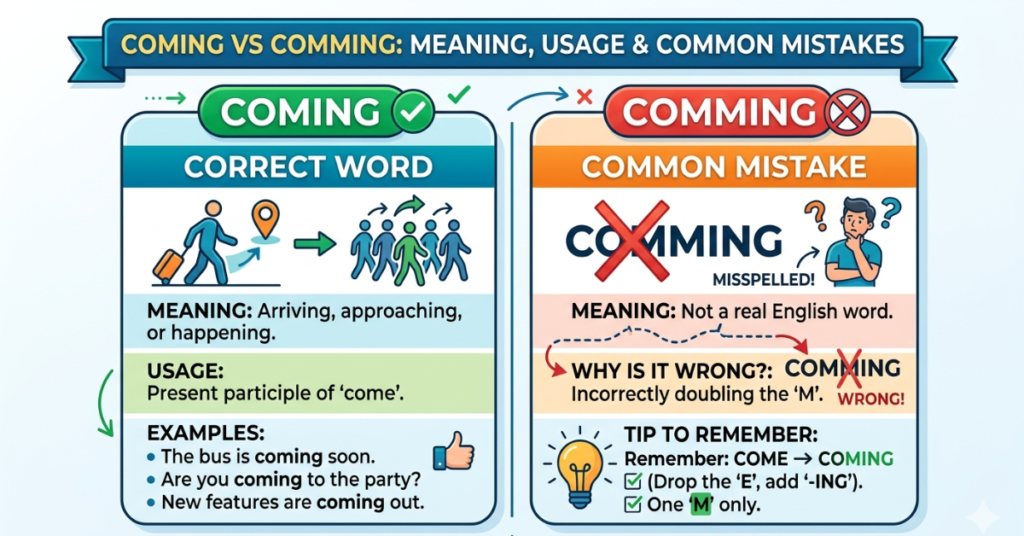
What Is the Correct Spelling: Coming or Comming?
Let’s clear it up right away:
- Coming = Correct spelling
- Comming = Incorrect spelling
The confusion around comming or coming usually comes from misunderstanding how English verbs change when adding “-ing.”
Why “Comming” Is Incorrect
The verb come becomes coming by simply adding -ing. Unlike some verbs, it does not double the “m.”
Examples:
- They are coming to the party.
- New movies are coming soon.
- The holidays are coming up quickly.
Coming Meaning Explained
The word coming is the present participle of come, and it generally means:
- Moving toward a place or person
- About to happen in the future
- Approaching in time
Common Uses of “Coming”
- Movement:
- She is coming home.
- Future Events:
- Big changes are coming soon.
- Announcements:
- New updates are coming up next week.
Why Do People Search for “Comming”?
Interestingly, terms like movies comming out or they are comming are frequently searched online. This happens because:
- English spelling rules can be inconsistent
- Pronunciation doesn’t always match spelling
- People type quickly without proofreading
Common Misspellings You Might See
- coming or comming
- comming vs coming
- comming out
- movies comming soon
These are all variations of the same spelling mistake.
Real-Life Examples of Correct Usage
Let’s look at how coming is used in everyday contexts:
Entertainment & Media
- New movies are coming out soon this summer.
- Fans are excited about what’s coming up in the next season.
Events & Occasions
- The holidays are coming up, so start planning early.
- Homecoming is coming next month.
Technology & Gaming
- Gamers often ask: When is GTA 6 coming out?
- Big updates are coming soon for popular apps.
Common Phrases You Should Know
Here are some frequently used phrases with correct spelling:
- Coming soon – Used for announcements
- Coming up – Refers to something about to happen
- Coming out – Used for releases or personal revelations
- Homecoming – A school or college event
Even though you may see variations like home comming dresses or home comming, the correct form is always coming.
Coming vs Comming: Quick Comparison
| Word | Correct? | Meaning |
|---|---|---|
| Coming | Yes | Approaching or arriving |
| Comming | No | Misspelling |
Tips to Avoid This Mistake
If you often mix up coming or comming, here are a few simple tricks:
- Remember: Come → Coming (no double “m”)
- Say it out loud: it sounds like “kuh-ming,” not “kom-ming”
- Use spell check tools when writing online
- Practice with simple sentences
FAQs
1. What is the correct spelling: coming or comming?
The correct spelling is coming. “Comming” is a common typo and not a real word.
2. Why do people write “comming” instead of “coming”?
It’s usually due to confusion about spelling rules or typing errors.
3. What does “coming” mean?
The coming meaning refers to something approaching, arriving, or about to happen.
4. Is “coming soon” grammatically correct?
Yes, “coming soon” is a correct and widely used phrase for announcements.
5. How do I remember the correct spelling?
Just remember that come becomes coming without doubling the “m.”
Conclusion
Understanding the difference between coming vs comming is simple once you know the rule: coming is always correct. Whether you’re talking about events, announcements, or future plans like movies coming out soon, using the right spelling makes your writing clearer and more professional.
Next time you’re typing quickly and hesitate between coming or comming, you’ll know exactly what to choose. Keep practicing, stay mindful, and your writing will improve naturally over time.