
Have you ever paused mid-sentence wondering whether to write cosy or cozy? You’re not alone. This tiny spelling difference sparks a surprisingly common debate among English speakers worldwide.
In this guide, we’ll break down cosy or cozy meaning, explain regional differences, and help you confidently decide which spelling to use in any situation. Whether you’re writing for a British, American, or global audience, you’ll leave with zero confusion.
What Does Cosy or Cozy Mean?
At its core, both spellings mean the same thing. Whether you write cosy or cozy, you’re describing something that feels:
- Warm and comfortable
- Relaxing and snug
- Pleasantly intimate or inviting
Think of a soft blanket, a warm cup of tea, or a small, welcoming space. That feeling? That’s what the word captures.
Common Examples
- A cosy/cozy living room
- A cosy/cozy winter evening
- A tea cosy or cozy (yes, both exist!)
Cosy or Cozy in English: What’s the Difference?
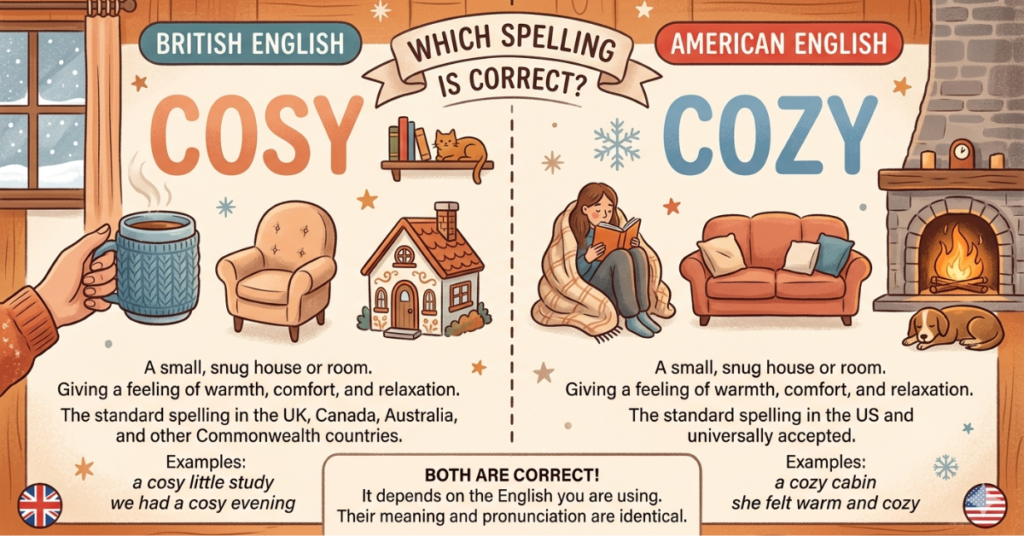
The difference comes down to geography rather than meaning.
British vs American English
- Cosy → Preferred in British English
- Cozy → Standard in American English
So if you’re asking is it cosy or cozy UK, the answer is clear: “cosy” is correct in the UK.
Meanwhile, in the United States, “cozy” dominates both formal and informal writing.
Regional Variations Around the World
English varies globally, so here’s how different regions handle the spelling:
: Cosy or Cozy UK
- “Cosy” is the standard spelling
- Used in books, media, and everyday writing
: Cosy or Cozy Australia & NZ
- “Cosy” is generally preferred
- Follows British English conventions
: Cosy or Cozy Canada
- Both spellings are accepted
- “Cozy” is slightly more common due to American influence
How Do You Spell Cosy or Cozy Correctly?
If you’re wondering how to spell cosy or cozy, the answer depends on your audience.
Quick Rule of Thumb:
- Writing for UK, Australia, or New Zealand? → Use cosy
- Writing for the US? → Use cozy
- Writing for a global audience? → Choose one and stay consistent
Consistency matters more than the choice itself.
Tea Cosy or Cozy: Which One Is Right?
This is a fun exception people often search for.
- In British English: tea cosy
- In American English: tea cozy
A tea cosy/cozy is the fabric cover used to keep a teapot warm—proof that even small cultural items reflect spelling differences.
Synonyms for Cosy or Cozy
If you want variety in your writing, here are some alternatives:
- Snug
- Comfortable
- Warm
- Inviting
- Homely (or “homey” in American English)
- Intimate
Using synonyms can improve readability and avoid repetition, especially in longer content.
Why Do Two Spellings Exist?
The difference dates back to the evolution of English spelling.
American English simplified many British spellings in the 18th–19th centuries. Words like:
- Colour → Color
- Favourite → Favorite
- Cosy → Cozy
This shift aimed to make spelling more phonetic and consistent.
Cosy or Cozy: Which Is Correct?
If you’re still asking cosy or cozy which is correct, here’s the simple truth:
Both are correct.
The “right” version depends entirely on context and location, not grammar rules.
FAQs
1. Is it cosy or cozy?
Both are correct. “Cosy” is British, while “cozy” is American.
2. Is it spelled cosy or cozy in the UK?
In the UK, “cosy” is the standard spelling.
3. Cosy or cozy in Australia and NZ?
“Cosy” is typically used in both Australia and New Zealand.
4. Which spelling is used in Canada?
Canada uses both, but “cozy” appears slightly more often.
5. How do you spell cosy or cozy in formal writing?
Use the version that matches your audience and stay consistent throughout your document.
6. What is the meaning of cosy or cozy?
It refers to a feeling of warmth, comfort, and relaxation.
Conclusion
Choosing between cosy or cozy doesn’t have to be confusing. Both spellings carry the same warm, comforting meaning, the only difference lies in regional usage.
If you’re writing for a specific audience, follow their standard. If not, pick one style and stick with it. Simple as that.
Now that you know the difference, you can write with confidence, and maybe even enjoy a cosy (or cozy!) moment while you’re at it.