
If you’ve ever paused mid-sentence wondering whether to write filed or filled, you’re not alone. The confusion around filed vs filled is incredibly common because the words sound similar but mean completely different things.
In this guide, we’ll break down the filed vs filled meaning, highlight the key differences, and show you exactly when to use each, without overthinking it.
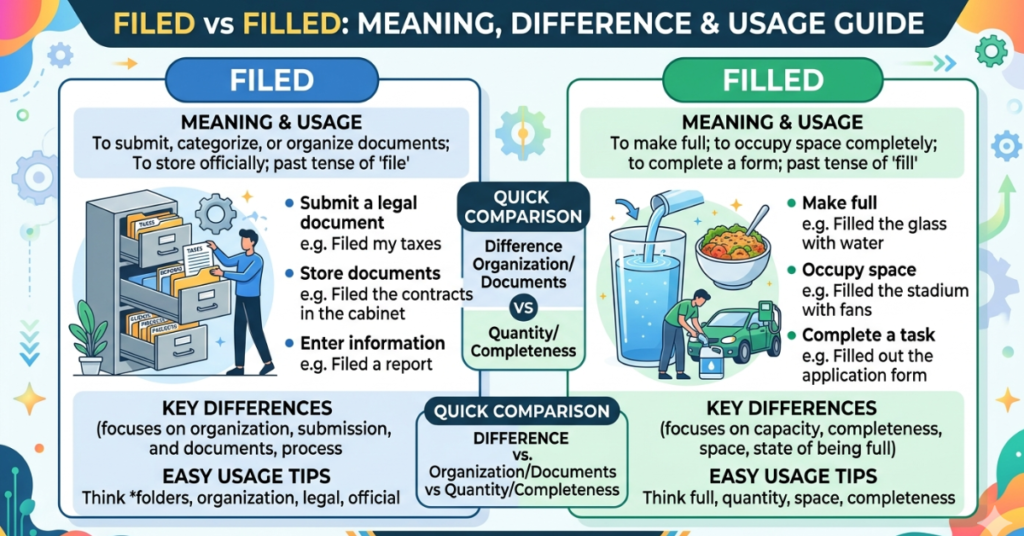
What Does “Filed” Mean?
The word filed comes from the verb “file,” and it usually relates to organizing, submitting, or officially recording something.
Common Uses of “Filed”
You’ll typically see filed used in administrative, legal, or office-related contexts.
Examples:
- She filed the documents in the cabinet.
- He filed a complaint against the company.
- They filed their taxes before the deadline.
Quick Tip:
Think of filed as something being organized or officially submitted.
What Does “Filled” Mean?
Filled is the past tense of “fill,” which means to make something full or to occupy space.
Common Uses of “Filled”
It’s often used in everyday situations involving physical or emotional fullness.
Examples:
- She filled the glass with water.
- The room was filled with laughter.
- He filled out the application form.
Quick Tip:
Think of filled as something being made full or completed.
Filed vs Filled Difference (Simple Breakdown)
Understanding the filed vs filled difference becomes much easier when you compare them side by side.
| Word | Meaning | Usage Context |
|---|---|---|
| Filed | Submitted or organized | Office, legal, documents |
| Filled | Made full or completed | Physical space, forms |
Key Distinction:
- Filed = About submission or organization
- Filled = About completion or fullness
When to Use Filed vs Filled
Let’s make this even more practical with a few clear scenarios.
Use “Filed” When:
- Submitting documents or paperwork
- Organizing records
- Taking legal or official action
Examples:
- She filed her report yesterday.
- They filed for divorce last year.
Use “Filled” When:
- Completing forms
- Adding something to make it full
- Describing emotions or environments
Examples:
- He filled the bucket with water.
- She filled out the survey online.
Common Mistakes to Avoid
Even fluent English speakers mix these up. Here are a few typical errors:
- I filed the form. (Incorrect if you mean completed it)
- I filled the form.
- She filled a complaint.
- She filed a complaint.
Easy Memory Trick:
- File = Folder → Filed = Submitted
- Fill = Full → Filled = Completed
Filed vs Filled Meaning in Everyday Language
In simple terms, the filed vs filled meaning comes down to intent:
- Are you submitting or organizing something? → Use filed
- Are you completing or making something full? → Use filled
Once you connect each word to its core idea, the confusion disappears.
FAQs About Filed vs Filled
1. What is the main difference between filed vs filled?
The main difference is that filed refers to submitting or organizing documents, while filled means making something full or completing it.
2. Can “filed” and “filled” ever be interchangeable?
No, they are not interchangeable. Using the wrong one can completely change the meaning of a sentence.
3. Is it “filed a form” or “filled a form”?
It depends:
- Filled a form = completed it
- Filed a form = submitted it officially
4. Why do people confuse filed vs filled?
They sound very similar when spoken, which leads to frequent mix-ups in writing.
5. How can I remember the correct usage?
Use this trick:
- Filed → Think of files and folders
- Filled → Think of something becoming full
Conclusion
Understanding the filed vs filled difference doesn’t have to be complicated. It all comes down to recognizing whether you’re talking about submission or completion.
To recap:
- Use filed for documents, complaints, and official actions
- Use filled for forms, containers, and anything being made full
Mastering this small distinction can make your writing clearer and more professional. If you want to sharpen your grammar even further, keep exploring similar word pairs, it’s one of the fastest ways to improve your English naturally.