

Ever paused mid-sentence and wondered, what is the plural of journey? You’re not alone. It’s one of those deceptively simple grammar questions that can trip up even confident writers.
In this article, we’ll break it down in a clear, conversational way—no confusing jargon. By the end, you’ll not only know the correct plural form but also understand why it works, so you won’t second-guess yourself again.
What Is the Plural of Journey?
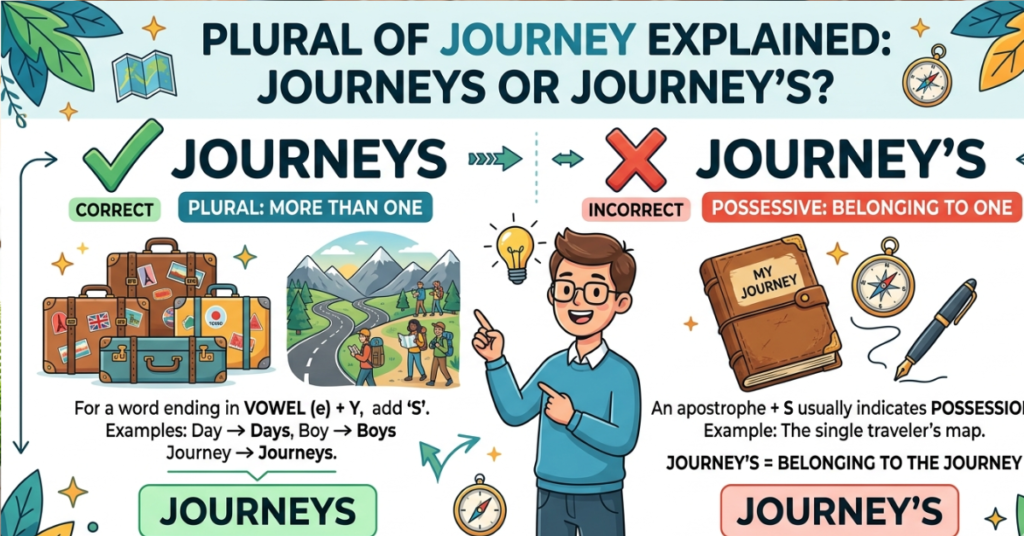
The correct plural of journey is journeys.
That’s it—simple and straightforward.
- Singular: journey
- Plural: journeys
If you’ve ever been tempted to write journey’s or journeies, you’re definitely not alone. Let’s clear up why those are incorrect.
Why Is It “Journeys” and Not Something Else?
Understanding the Rule
The word journey ends with a vowel + “y” (the vowel here is e).
When forming plurals:
- If a word ends in vowel + y, just add -s
- If it ends in consonant + y, change y → ies
Examples to Compare
Vowel + Y (add -s):
- journey → journeys
- toy → toys
- key → keys
Consonant + Y (change to -ies):
- city → cities
- baby → babies
- story → stories
So, since journey has a vowel before the “y,” it follows the first rule.
Common Mistakes to Avoid
Even though the rule is simple, mistakes still happen. Here are the most common ones:
Journey’s
- This is possessive, not plural
- Example: The journey’s end was beautiful
Journeies
- This is a spelling error
- Happens when people mix up plural rules
Journeys
- The correct plural form
- Example: Their journeys across the world were unforgettable
Quick Memory Trick
If you’re ever unsure, try this:
“If there’s a vowel before the ‘y,’ just add ‘s.’”
It’s a simple rule, but it works almost every time.
Using “Journeys” in Sentences
To make things stick, here are a few natural examples:
- Life is made up of many journeys, not just one destination.
- Their journeys through different countries changed them forever.
- We all have personal journeys that shape who we become.
Notice how smoothly “journeys” fits—no awkward spelling or punctuation needed.
Related Grammar Tips (LSI Keywords)
If you’re learning this, you might also find these helpful:
- plural rules in English
- words ending in y plural
- difference between plural and possessive
- English grammar basics
Understanding these will help you avoid similar mistakes with other words.
FAQs
1. What is the plural of journey?
The plural of journey is journeys.
2. Why is it not “journeies”?
Because journey ends in a vowel + “y,” you simply add -s instead of changing “y” to “ies.”
3. Is “journey’s” ever correct?
Yes, but only for possession—not plural.
Example: The journey’s purpose was unclear.
4. Are there exceptions to this rule?
Generally, no. Words ending in vowel + “y” almost always just take -s in plural form.
5. How can I remember the rule easily?
Check the letter before “y.”
- Vowel → add s
- Consonant → change to ies
Conclusion
So, what is the plural of journey? It’s simply journeys—no apostrophe, no complicated spelling.
Once you understand the vowel + “y” rule, it becomes second nature. Grammar doesn’t have to be intimidating; sometimes it’s just about knowing a small pattern and applying it consistently.
If you found this helpful, keep exploring similar grammar rules—you’ll be surprised how quickly your writing sharpens up.