
If you’ve ever come across “WTV” in a message and paused for a second, you’re not alone. The wtv meaning text is one of those modern slang shortcuts that can feel confusing at first—but once you get it, it’s surprisingly simple.
In today’s fast-paced digital conversations, abbreviations like WTV help people communicate quickly while still expressing tone and emotion. This article breaks down what WTV means, how people use it, and how you can confidently understand or use it yourself.
What Does WTV Mean in Text?
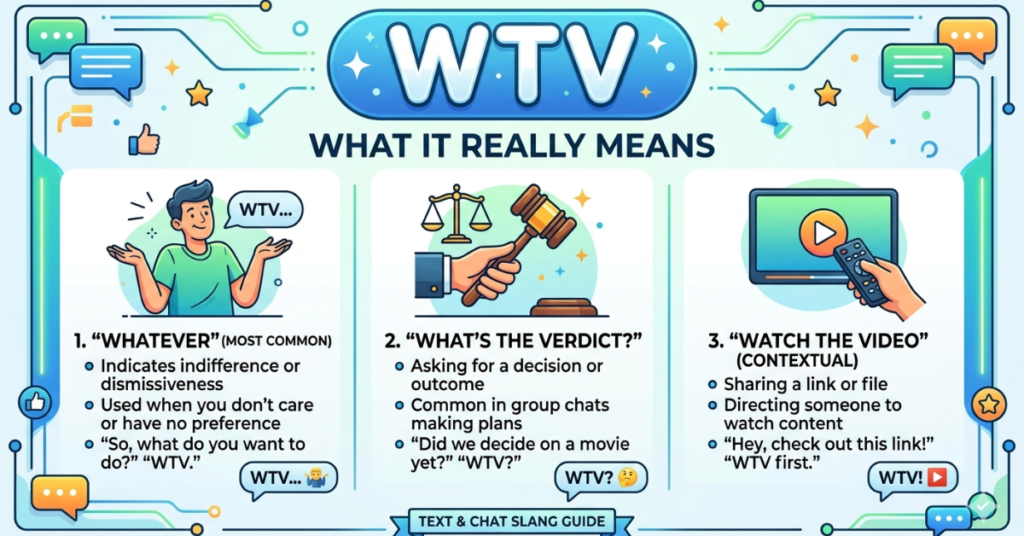
At its core, WTV is short for “whatever.”
It’s commonly used in texting, social media, and casual online chats. Depending on context, it can carry different tones—from relaxed and indifferent to slightly dismissive.
Common Interpretations:
- Neutral: “It doesn’t matter.”
- Casual: “Anything is fine.”
- Dismissive: “I don’t care anymore.”
How WTV Is Used in Conversations
Understanding the wtv meaning text really comes down to context. The same word can feel completely different depending on how it’s used.
1. Casual Agreement
Sometimes, WTV is used in a laid-back way when someone doesn’t have a strong opinion.
Example:
- “What do you want to eat?”
- “WTV, you pick.”
Here, it simply means “I’m okay with anything.”
2. Indifference or Lack of Interest
WTV can also signal that someone doesn’t really care about the outcome.
Example:
- “We can go tomorrow instead.”
- “WTV.”
This feels more indifferent than engaged.
3. Frustration or Dismissiveness
In certain situations, WTV can come across as slightly annoyed.
Example:
- “You never listen to me.”
- “WTV.”
In this case, it may signal emotional distance or frustration.
Why People Use WTV in Texting
Short forms like WTV exist for a reason—they make communication faster and more expressive.
Key Reasons:
- Speed: Saves time when typing
- Convenience: Fits casual conversations
- Tone flexibility: Can express mood subtly
- Digital culture: Popular in chats, memes, and social media
When You Should (and Shouldn’t) Use WTV
Even though it’s simple, using WTV the wrong way can lead to misunderstandings.
Use WTV When:
- You’re chatting casually with friends
- You genuinely don’t mind the outcome
- The conversation is informal
Avoid WTV When:
- Talking in professional or formal settings
- The situation is emotionally sensitive
- You want to show enthusiasm or care
Similar Slang Terms to WTV
To fully grasp the wtv meaning text, it helps to know related expressions.
Common Alternatives:
- IDC – I don’t care
- IDK – I don’t know
- NVM – Never mind
- BRB – Be right back
Each has a slightly different tone, but they often appear in the same type of conversations.
How Tone Changes Meaning
One of the most important things to remember is that tone isn’t always obvious in text.
Compare These:
- “WTV” → relaxed and friendly
- “WTV.” → blunt or cold
- “wtv…” → possibly annoyed or tired
Even punctuation and emojis can completely change how WTV feels.
FAQs About WTV Meaning in Text
1. Is WTV rude?
Not always. It depends on context and tone. It can be neutral, but in some situations, it may come off as dismissive.
2. Is WTV the same as “whatever”?
Yes, WTV is simply an abbreviation for “whatever,” used in casual digital communication.
3. Can I use WTV in professional messages?
It’s best to avoid it in formal or professional communication, as it may seem unprofessional or careless.
4. Why do people use WTV instead of typing the full word?
Mainly for speed and convenience. It’s part of modern texting culture.
5. Does WTV always mean someone doesn’t care?
No. Sometimes it just means they’re flexible or easygoing—it’s not always negative.
Conclusion
The wtv meaning text is straightforward once you understand the context—it simply stands for “whatever.” But like many texting shortcuts, its tone can shift depending on how and where it’s used.
By paying attention to context, punctuation, and the flow of conversation, you can easily interpret (and use) WTV without confusion. If you’re navigating modern slang, mastering small abbreviations like this goes a long way in understanding digital communication.
Want to get even better at texting slang? Keep exploring similar terms and you’ll quickly sound more natural in any online conversation.