

Ever paused mid-sentence and wondered whether to write realized or realised? You’re not alone. This is one of those classic spelling dilemmas that trips up even confident writers.
In this guide, we’ll break down the realized or realised meaning, explain regional differences, and show you exactly when to use each form. By the end, you’ll never second-guess your spelling again.
What Does “Realized/Realised” Mean?
Before diving into spelling, let’s clarify the meaning. Both forms come from the verb realize, which generally means:
- To become aware of something
- To understand something clearly
- To achieve or accomplish something
For example:
- I just realized I left my keys at home.
- She realised her dream of becoming a doctor.
The meaning stays exactly the same—only the spelling changes.
Realized or Realised: What’s the Difference?
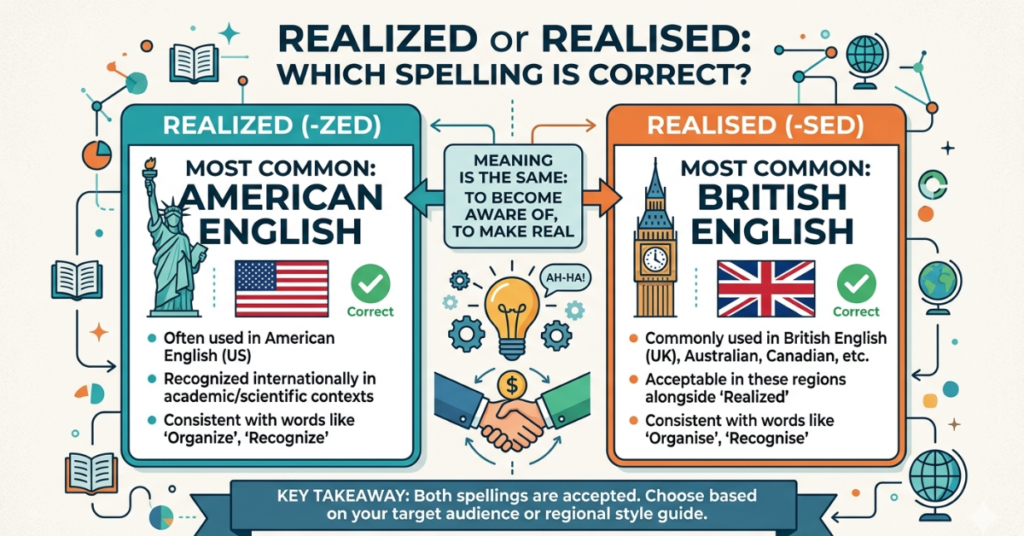
The difference between realized or realised is purely regional.
American English (US)
- Preferred spelling: realized
- Used in: United States
Example:
- I realized the mistake too late.
British English (UK)
- Preferred spelling: realised
- Used in: United Kingdom
Example:
- He realised the truth after the meeting.
Realized or Realised UK, Canada, and Australia
Let’s look at how different countries handle this:
United Kingdom
- Common form: realised
- However, some British publications also accept -ize endings.
Canada
- Both realized or realised Canada versions are acceptable
- Usage depends on style guides or personal preference
Australia
- Preferred spelling: realised
- Follows British conventions
How Do You Spell Realized or Realised?
If you’re asking how do you spell realized or realised, the answer depends on your audience.
Here’s a quick rule of thumb:
- Writing for US readers → use realized
- Writing for UK/Australia → use realised
- Writing for Canada → either is fine, but stay consistent
Consistency matters more than the choice itself.
Common Usage Examples
Let’s clear up some everyday phrases people often search for:
I Realized or Realised
- US: I realized I was wrong.
- UK/AUS: I realised I was wrong.
Just Realized or Realised
- US: I just realized something important.
- UK: I just realised something important.
I Just Realized or Realised
Both are correct depending on region, but don’t mix styles in the same document.
Why Do These Spelling Differences Exist?
English spelling varies because of historical influences.
- American English simplified many words (e.g., color, organize)
- British English retained older forms (e.g., colour, organise)
Interestingly, the -ize ending actually has Greek origins and is technically correct in British English too—though -ise is more commonly used.
Tips to Avoid Confusion
Here are some practical tips to stay consistent:
- Know your audience: Are you writing for US, UK, or global readers?
- Stick to one style: Don’t mix realized and realised in the same piece
- Use tools wisely: Spell-checkers can be set to specific regions
- Follow style guides: Academic or professional writing often has strict rules
FAQs
1. Is it realized or realised?
Both are correct. The choice depends on whether you’re using American or British English.
2. What is the realized or realised meaning?
Both mean becoming aware of something or achieving something. There’s no difference in meaning.
3. Is it realized or realised in the UK?
In the UK, realised is more commonly used.
4. Realized or realised Canada—which is correct?
In Canada, both spellings are accepted. Just stay consistent.
5. Which is correct: I realized or realised?
Both are correct depending on your regional spelling preference.
6. Is it realized or realised in Australia?
Australia typically uses realised, following British English.
Conclusion
So, realized or realised? The answer is simple: both are correct—it just depends on where you are and who you’re writing for.
The key takeaway is consistency. Choose one spelling style based on your audience and stick with it throughout your writing.
Now that you understand the difference, you can write confidently without second-guessing yourself. Want to improve your grammar even further? Keep exploring common English variations—you’ll sharpen your writing faster than you think.