
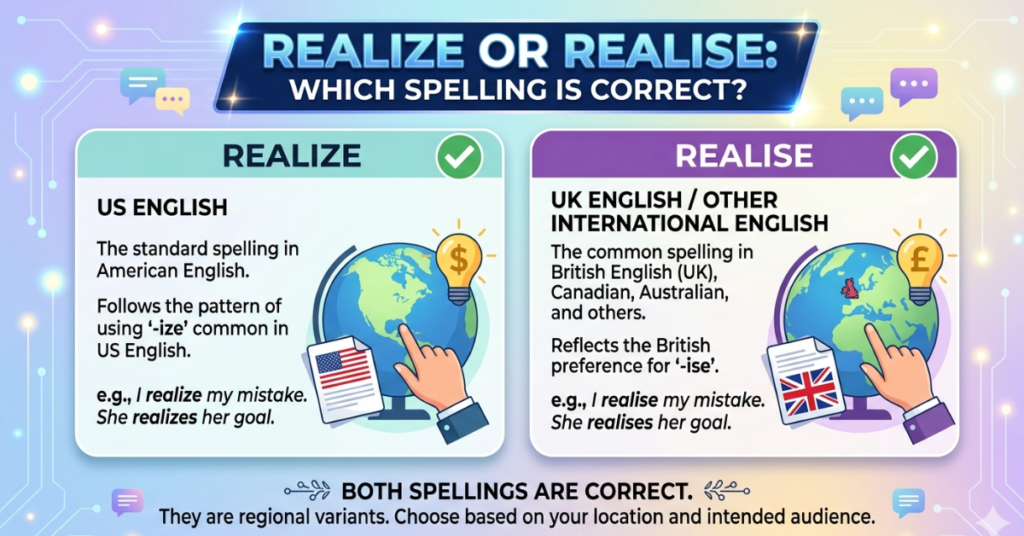

Have you ever paused mid-sentence wondering whether to write realize or realise? You’re not alone. This is one of the most common spelling dilemmas in English, and the confusion comes down to geography, not correctness.
In this guide, we’ll break down realize or realise, explain which one is correct depending on where you are, and help you use the right spelling with confidence.
Realize or Realise: Which Is Correct?
Let’s clear this up right away:
Both “realize” and “realise” are correct.
The difference lies in regional spelling conventions:
- “Realize” → American English
- “Realise” → British English (and often used in other regions influenced by it)
So if you’re asking “is it realize or realise?”, the answer depends on where your audience is located.
Why Are There Two Spellings?
The variation between realize or realise comes from historical differences in English spelling systems.
A Quick Background
- American English favors -ize endings (realize, organize, recognize)
- British English often prefers -ise endings (realise, organise, recognise)
Interestingly, the -ize form actually has Greek origins, and some British institutions (like Oxford) still prefer “realize” over “realise.”
Realize or Realise Meaning
No matter how you spell it, the meaning stays exactly the same.
“Realize / Realise” means:
- To become aware of something
- To understand clearly
- To achieve or accomplish something
Examples:
- I didn’t realize how late it was.
- She finally realised her dream of becoming a doctor.
The spelling changes, but the meaning does not.
How to Spell Realize or Realise in Different Countries
If you’re still wondering “how to spell realize or realise”, here’s a simple breakdown:
🇺🇸 United States
- Preferred spelling: Realize
🇬🇧 United Kingdom
- Common spelling: Realise
- Oxford style: Realize (yes, both exist!)
🇨🇦 Canada
- Both are used, but:
- Realize is increasingly common
- Realise is still accepted
🇦🇺 Australia & 🇳🇿 New Zealand
- Preferred spelling: Realise
Realize or Realise in Canada: What Should You Use?
A common question is: “is it realize or realise in Canada?”
In Canadian English:
- Both spellings are accepted
- However, “realize” is becoming more standard, especially in business and digital writing
Tip: Stay consistent within a document.
When Should You Use Realize vs Realise?
Here’s a simple rule to follow:
Use “realize” if:
- You’re writing for an American audience
- You want a more globally accepted, modern standard
Use “realise” if:
- You’re writing for a British or Australian audience
- You’re following traditional UK spelling conventions
Common Mistakes to Avoid
When dealing with realize or realise, people often make these mistakes:
- Mixing both spellings in one document
- Assuming one is incorrect (both are valid!)
- Ignoring audience location
Pro Tip:
Pick one spelling style and stick to it throughout your writing.
Related Words with Similar Differences
The same pattern appears in other words:
| American English | British English |
|---|---|
| Organize | Organise |
| Recognize | Recognise |
| Analyze | Analyse |
Once you understand realize or realise, the rest becomes easier.
FAQs About Realize or Realise
1. Is it realize or realise?
Both are correct. “Realize” is American English, while “realise” is British English.
2. Which is correct: realize or realise?
Neither is more correct universally—it depends on your region and audience.
3. How do you spell realize or realise in formal writing?
Use the version that matches your chosen style guide (APA uses “realize,” while UK styles may prefer “realise”).
4. Is “realize” acceptable in the UK?
Yes, especially in Oxford English, though “realise” is more common.
5. Is it spelled realize or realise in Canada?
Both are accepted, but “realize” is increasingly preferred.
6. Does realize or realise have different meanings?
No, both spellings have exactly the same meaning.
Conclusion
So, when it comes to realize or realise, the real takeaway is simple:
It’s not about right or wrong—it’s about where and who you’re writing for.
- Use “realize” for American or global audiences
- Use “realise” for British-style writing
Consistency is key. Pick one style and stick with it to keep your writing clean and professional.
If you found this helpful, you might want to explore other commonly confused words in English—it’s a quick way to sharpen your writing skills.