
Ever paused mid-sentence wondering, “how do you spell realized?” You’re not alone. This small spelling question trips up writers, students, and even professionals—especially when you notice two versions floating around: realized and realised.
In this guide, we’ll break it down clearly and simply. You’ll learn the correct spelling, when to use each variation, and how English differences (like American vs British) play a role.
How Do You Spell Realized?
The straightforward answer:
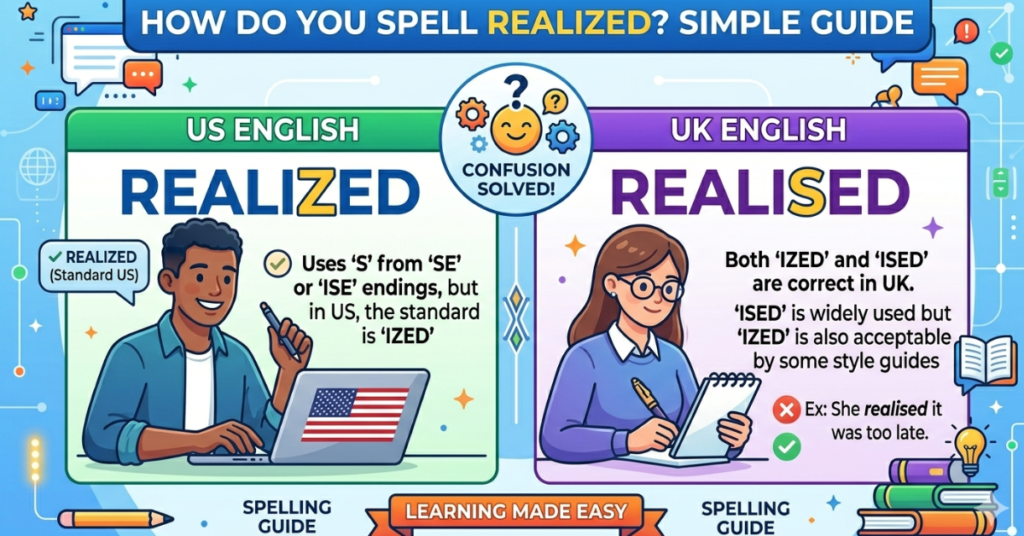
“Realized” is spelled R-E-A-L-I-Z-E-D.
This is the standard American English spelling.
If you’re writing for a U.S. audience, using apps, or following American grammar rules, realized is the correct choice.
Realized vs Realised: What’s the Difference?
This is where confusion usually starts.
Key Difference
- Realized → American English 🇺🇸
- Realised → British English 🇬🇧
Both spellings are correct, but they depend on the version of English you’re using.
Why Two Spellings Exist
English evolved differently in various regions. In American English, verbs often use -ize, while British English frequently uses -ise.
Examples:
- Realized / Realised
- Organized / Organised
- Recognized / Recognised
How Do You Spell Realized in English?
If you’re asking how do you spell realized in English, the answer depends on context:
- Writing for American English → use realized
- Writing for British English → use realised
There’s no “wrong” version—just the wrong one for your audience.
When Should You Use “Realized”?
Use realized when:
- You’re writing for U.S.-based readers
- Your document follows American grammar rules
- You’re using tools like Microsoft Word or Google Docs set to U.S. English
Example Sentences:
- I suddenly realized I forgot my keys.
- She realized her mistake too late.
When Should You Use “Realised”?
Use realised when:
- Writing for UK, Australia, or other British English regions
- Following British spelling conventions
Example:
- He realised the truth after years of doubt.
Common Search Queries Explained
People often search things like:
“Google how do you spell realized”
Search engines will usually return “realized” first because American English dominates online content.
“Hey Google how do you spell realized”
Voice assistants typically default to American pronunciation and spelling, unless your device is set to a UK region.
“How do you spell realized or realised”
The correct answer: both are right, just used in different regions.
Easy Trick to Remember the Difference
Here’s a quick memory tip:
- Z = American (Z for “USA Zoom”)
- S = British (S for “Standard UK Style”)
Not official—but surprisingly helpful!
Related Term: BWC Meaning (Quick Note)
You might also come across unrelated trending searches like “bwc meaning urban dictionary.” While it has nothing to do with spelling realized, it’s an example of how search queries can mix language questions with slang. Always double-check context when searching!
FAQs
1. Is “realized” correct spelling?
Yes, realized is the correct spelling in American English.
2. Is “realised” wrong?
No, it’s correct in British English.
3. Which spelling should I use in school?
Follow your institution’s guidelines. Most use either American or British English consistently.
4. Why does Google show “realized” more often?
Because American English dominates online content and search indexing.
5. Can I use both spellings in the same document?
It’s best not to. Stick to one style for consistency.
Conclusion
So, how do you spell realized? The answer is simple: R-E-A-L-I-Z-E-D in American English. But remember, realised is equally valid in British English.
The key takeaway is consistency—choose one style based on your audience and stick with it. That small detail can make your writing look more polished and professional.
If you’re ever unsure, just think about who you’re writing for—and you’ll always pick the right spelling.