
Ever found yourself typing comming and wondering if it looks a bit off? You’re not alone. The confusion around comming or coming is surprisingly common, especially for English learners and even native speakers rushing through a sentence.
In this article, we’ll break down the comming or coming meaning, explain which spelling is correct, and show you how to use it confidently in everyday writing. By the end, you’ll never hesitate again.
Comming or Coming: Which Is Correct?
Let’s clear this up right away:
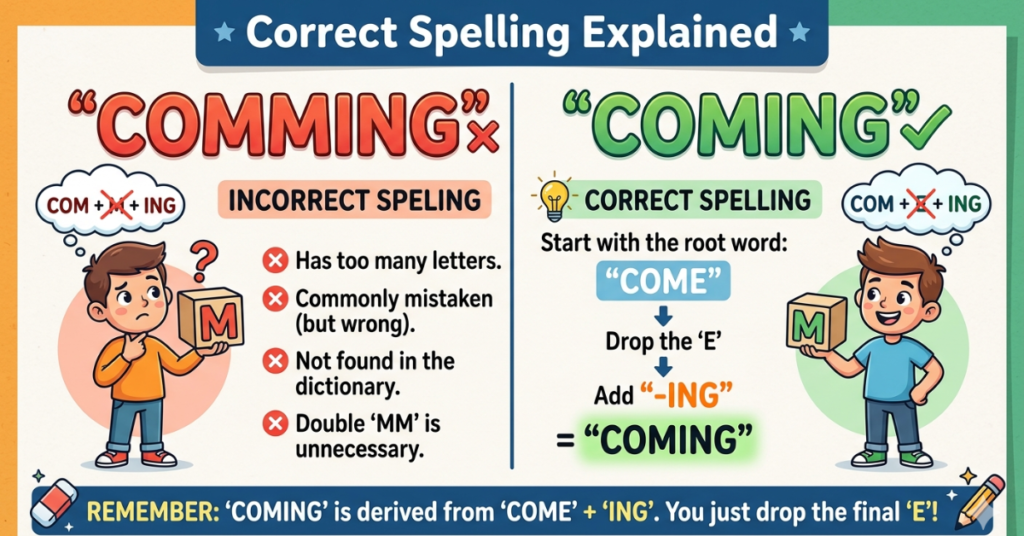
The correct spelling is coming
“Comming” is incorrect
If you’ve been asking yourself “is it comming or coming?”, now you know—the version with one “m” is the only correct one in standard English.
What Does “Coming” Mean?
The word coming is the present participle of the verb come. It refers to movement toward a place, event, or state.
Common meanings include:
- Moving closer (e.g., “She is coming home.”)
- About to happen (e.g., “Winter is coming.”)
- Arriving soon (e.g., “The bus is coming.”)
This explains the comming or coming meaning in English—only coming carries these meanings.
Why Do People Write “Comming”?
This mistake usually comes from confusion about spelling rules in English.
Here’s why it happens:
- People assume the consonant should double (like “running” from “run”)
- Fast typing or autocorrect errors
- Lack of familiarity with irregular spelling patterns
The rule:
For the verb “come”, you simply add -ing → coming
❌ Not: comming
Comming or Coming Difference Explained
Let’s make it crystal clear:
| Word | Status | Meaning |
|---|---|---|
| Coming | ✅ Correct | Moving toward or arriving |
| Comming | ❌ Incorrect | Not a valid English word |
So, if you’re comparing comming or coming difference, there really isn’t a functional difference—only one is real.
How to Use “Coming” in Sentences
Here are some natural examples:
- “I’m coming to the meeting in 10 minutes.”
- “Good news is coming soon.”
- “Are you coming with us?”
Notice how smooth and natural coming feels in every context.
“Coming Soon” vs “Comming Soon”
You’ve probably seen phrases like:
- Coming soon (correct)
- Comming soon (incorrect)
If you’re creating content, ads, or social media posts, always use the correct version. Even small spelling errors can affect credibility.
Quick Tips to Remember the Correct Spelling
If you still hesitate between comming or coming correct spelling, try these tricks:
- Think: Come → Coming (just add -ing)
- No double “m” needed
- Say it out loud—it doesn’t sound like it has a double “m”
FAQs
1. Which is correct: comming or coming?
The correct spelling is coming. “Comming” is incorrect and not used in proper English.
2. Is it comming or coming in formal writing?
Always use coming in both formal and informal writing.
3. Why is “comming” wrong?
Because the base verb come does not double the “m” when adding “-ing.”
4. What does “coming” mean in English?
It refers to arriving, approaching, or happening soon.
5. Can “comming” ever be correct?
No, “comming” is always considered a spelling mistake.
Conclusion
To sum it up, the debate over comming or coming is easy to resolve once you know the rule: coming is the only correct spelling. Understanding this small detail can make your writing clearer, more professional, and more trustworthy.
Next time you type the word, you won’t need to second-guess yourself. And if you’re working on improving your English, mastering these tiny distinctions can make a big difference.
Keep practicing, stay curious, and don’t hesitate to explore more common grammar mistakes—you’ll sharpen your skills faster than you think.