
Have you ever paused mid-sentence wondering whether to write bearing down or baring down? You’re not alone. This common confusion trips up writers, students, and even professionals. The phrase may sound identical when spoken, but only one form is correct in most contexts.
In this article, we’ll break down the difference between bearing down or baring down, explain their meanings, and show you exactly when to use each—so you never second-guess yourself again.
What Does “Bearing Down” Mean?
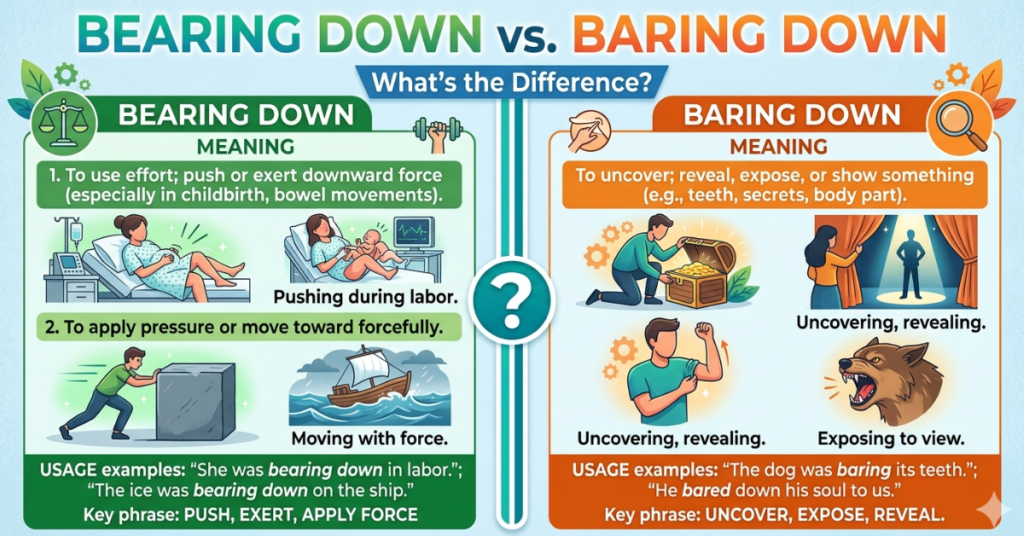
“Bearing down” is the correct and widely accepted phrase in most situations. It comes from the verb “bear,” which has several meanings, including to carry, to endure, or to press forward.
Common Meanings of “Bearing Down”
Depending on context, “bearing down” can mean:
- Applying pressure or force
- Example: The driver was bearing down on the brakes.
- Focusing intensely
- Example: She is bearing down on her studies before exams.
- Moving toward something with force
- Example: A storm is bearing down on the coast.
Why It’s Used So Often
“Bearing down” is versatile and works in both literal and figurative contexts. That’s why it’s the phrase you’ll see in:
- News reports
- Academic writing
- Everyday conversation
What Does “Baring Down” Mean?
“Baring down” is much less common—and often incorrect in everyday usage. The verb “bare” means to uncover or expose.
When “Baring Down” Might Be Used
Technically, “baring down” could make sense in very specific contexts, such as:
- Revealing or exposing something downward
- Example: He was baring down his teeth in anger (though even here, “baring his teeth” is more natural)
However, in most cases where people write “baring down,” they actually mean “bearing down.”
Bearing Down or Baring Down: Key Differences
Here’s a simple way to remember:
| Phrase | Meaning | Common Usage |
|---|---|---|
| Bearing down | Applying pressure or focusing | Correct in most cases |
| Baring down | Exposing or uncovering (rare) | Rarely correct |
Quick Tip
If you’re talking about effort, pressure, or movement, the correct choice is almost always bearing down.
Examples to Make It Clear
Let’s look at a few examples to lock this in:
Correct Usage (Bearing Down)
- The deadline is close, so I’m bearing down on my work.
- The hurricane is bearing down on the city.
- He was bearing down with all his strength.
Incorrect Usage (Baring Down)
- She is baring down on her project.
- The car came baring down the road.
In both cases above, “bearing” is the correct word.
Why This Confusion Happens
English is full of homophones, words that sound the same but have different meanings. “Bearing” and “baring” are classic examples.
Common Reasons for the Mix-Up
- Identical pronunciation
- Similar spelling
- Lack of context awareness
The brain often defaults to what “looks right,” especially when typing quickly.
How to Remember the Correct Form
Here’s a simple trick:
- “Bear” = Carry or push → Bearing down (correct)
- “Bare” = Expose → Baring (rarely used here)
Memory Shortcut
Think:
You “bear” weight, pressure, or responsibility
So you bear down, not bare down
FAQs
1. Is “baring down” ever correct?
Yes, but only in rare cases where “bare” (to expose) makes sense. In most everyday writing, it’s incorrect.
2. Which is correct: bearing down or baring down?
“Bearing down” is correct in nearly all contexts, especially when referring to pressure, focus, or movement.
3. Why do people confuse bearing and baring?
Because they sound exactly the same and have similar spellings, making them easy to mix up.
4. Can I use “bearing down” in formal writing?
Absolutely. It’s widely accepted in both formal and informal contexts.
5. What’s a simple way to avoid the mistake?
Remember:
If it involves effort or force, use bearing down.
Conclusion
Understanding the difference between bearing down or baring down is simpler than it seems. In most situations, bearing down is the correct and appropriate choice, whether you’re talking about pressure, focus, or movement.
The next time you’re writing and hesitate, just recall this:
If it’s about pushing forward or applying effort, you’re bearing down.
Mastering small distinctions like this not only improves your writing but also builds confidence. Keep practicing, and you’ll spot these tricky word pairs instantly.